Inuit People
Inuit (plural: the singular, Inuk, means "man" or "person") is a general term for a group of culturally similar indigenous peoples inhabiting the Arctic regions of Alaska, Greenland, and Canada,
and Siberia. - http://www.newworldencyclopedia.org/entry/Inuit
The Inuit (formerly called Eskimo, although this term is now considered offensive by most) are a group of culturally similar indigenous peoples inhabiting the Arctic regions of Canada (Northwest Territories, Nunatsiavut, Nunavik, Nunavut, Nunatukavut), Denmark (Greenland), Russia (Siberia) and the United States (Alaska). Inuit means “the people” in the Inuktitut language. An Inuk is singular for Inuit person, whereas Inuit is Plural. The Inuit language is grouped under Eskimo–Aleut languages.
The Inuit live throughout most of the Canadian Arctic and subarctic: in the territory of Nunavut ("our land"); the northern third of Quebec, in an area called Nunavik ("place to live"); the coastal region of Labrador, in areas called Nunatsiavut ("our beautiful land") and Nunatukavut ("Our Ancient Land"); in various parts of the Northwest Territories, mainly on the coast of the Arctic Ocean and formerly in the Yukon. Collectively these areas are known as Inuit Nunangat.- http://en.wikipedia.org/wiki/Inuit
The Inuit (formerly called Eskimo, although this term is now considered offensive by most) are a group of culturally similar indigenous peoples inhabiting the Arctic regions of Canada (Northwest Territories, Nunatsiavut, Nunavik, Nunavut, Nunatukavut), Denmark (Greenland), Russia (Siberia) and the United States (Alaska). Inuit means “the people” in the Inuktitut language. An Inuk is singular for Inuit person, whereas Inuit is Plural. The Inuit language is grouped under Eskimo–Aleut languages.
The Inuit live throughout most of the Canadian Arctic and subarctic: in the territory of Nunavut ("our land"); the northern third of Quebec, in an area called Nunavik ("place to live"); the coastal region of Labrador, in areas called Nunatsiavut ("our beautiful land") and Nunatukavut ("Our Ancient Land"); in various parts of the Northwest Territories, mainly on the coast of the Arctic Ocean and formerly in the Yukon. Collectively these areas are known as Inuit Nunangat.- http://en.wikipedia.org/wiki/Inuit
taken from: http://www.civilization.ca/cmc/exhibitions/tresors/art_inuit/inart29e.shtml
Inuit society is loosely organized into family groups that rely on
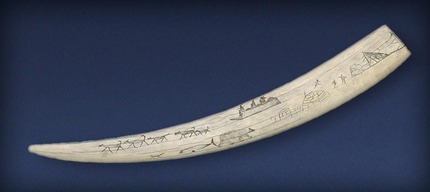
hunting and fishing for survival. The images created by Inuit artists
reveal the importance attached to the animals they relied on for food-
seal, walrus, fish, whale, and caribou. Other animals such as fox, wolf,
and bear were also represented in their art. The human figure was shown
in the mask and dolls that they created.
Figures are also found on the engravings done on walrus ivory. in these engravings, Inuit artists used a kind of pictorial writing that describes various activities and events associated with everyday life. In one such engraving on an ivory pipestream a series of lively drawings record the activities associated with the daily quest for food. Since the surface of this pipestream is less than one inch wide, the engraving takes the form of tiny, decorative circles and miniature figures. despite their small size the artist still managed to present an easy to read account of the hunt. to accent the engraved lines used in works like this artists filled them with colour or made them dark with soot. Frequently Inuit art was created to serve the religious needs of the people. 1
Figures are also found on the engravings done on walrus ivory. in these engravings, Inuit artists used a kind of pictorial writing that describes various activities and events associated with everyday life. In one such engraving on an ivory pipestream a series of lively drawings record the activities associated with the daily quest for food. Since the surface of this pipestream is less than one inch wide, the engraving takes the form of tiny, decorative circles and miniature figures. despite their small size the artist still managed to present an easy to read account of the hunt. to accent the engraved lines used in works like this artists filled them with colour or made them dark with soot. Frequently Inuit art was created to serve the religious needs of the people. 1
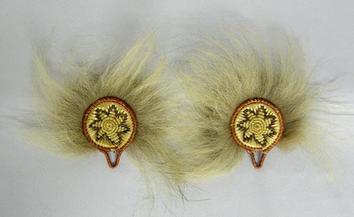
Finger Masks
When [Inuit] women dance, their
hands are active and expressive while their feet often remain still,
and they generally accent their hand movements with finger masks. (Men participate in these dances as well however they take a kneeling position on the floor in front of the women.) The
central part of the mask, like the face mask, often displays a
circle-within-a-circle motif which represents the cosmos. Sometimes
finger masks portray a toothy inua, or they may represent
smiling male guardian spirits, frowning female spirits or mythical
beasts. -http://www2.grand-forks.k12.nd.us/ms/iditarod/fingermasks.html
Additional resources:
http://en.wikipedia.org/wiki/Masks_among_Eskimo_peoples
http://en.wikipedia.org/wiki/Inuit
1Ragans, Rosalind. "Chapter 12: Art Traditions From Around the Wold." Arttalk. New York, NY: Glencoe/McGraw-Hill, 2000. 341-45. Print.
Additional resources:
http://en.wikipedia.org/wiki/Masks_among_Eskimo_peoples
http://en.wikipedia.org/wiki/Inuit
1Ragans, Rosalind. "Chapter 12: Art Traditions From Around the Wold." Arttalk. New York, NY: Glencoe/McGraw-Hill, 2000. 341-45. Print.
